


A couple weeks ago, two stories quietly collided in my brain and refused to let go. On the surface, they felt like internet curiosities with headline fodder and comment-section chaos sparking healthy debate. But underneath, they hinted at something much bigger: a cultural shift that’s been building for years.
Both stories essentially posed the question: what if dogs were legally treated like family?
Not metaphorically. Not emotionally. Legally.

First, I was swept up by the social roar of an Instagram post from @seniormuttsmatter. The kind of post that racks up tens of thousands of shares because it says the thing so many people already feel but haven’t fully articulated yet. The message was simple, almost obvious: dogs aren’t “property.” They’re family.
And the comments did not disappoint:

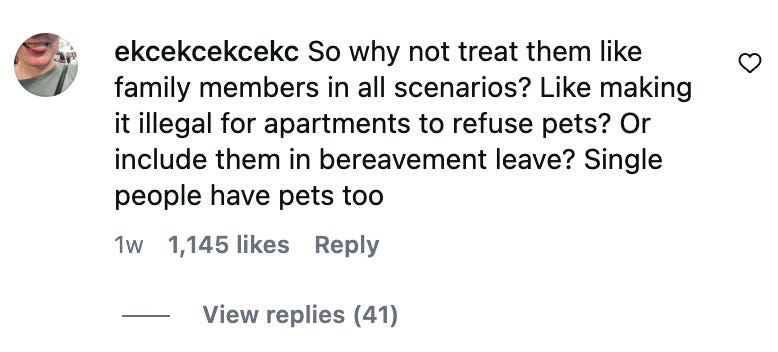


The Legal Shift We Didn’t See Coming
Pennsylvania’s move isn’t about dogs suddenly getting Social Security numbers, or rewriting the definition of personhood. It’s more nuanced than that. The recognition centers on acknowledging the emotional value of companion animals in certain legal cases, rather than reducing them to replaceable property with a dollar value.
That distinction matters.
Historically, if someone harmed or killed your dog, the law treated it much like damaging a couch. Compensation was based on market value, not emotional loss.
Over the last 20 years, that framework has begun to strain. Courts and legislatures have carved out narrow exceptions by allowing limited noneconomic damages in some cases, considering pets in protective orders and custody disputes, and increasingly acknowledging their role as companions rather than mere property. Recognizing dogs as family members challenges a long-standing legal category, and even these incremental shifts reflect a meaningful philosophical change.
It signals that the law may finally be paying attention to how people actually live.
And Then There’s the IRS Lawsuit
Days later, I read about a lawsuit challenging the IRS. Filed by Amanda Reynolds, a New York lawyer arguing that dogs should be eligible to be claimed as dependents on tax returns. Yes, really.
Giyoh Shey sums it up quite well:
At first, I laughed. Every year at tax time, I make the same joke: I should be able to claim my three dogs, who cost roughly the equivalent of one child — if not more.
I was excited that there might be a case here. And it seemed a good majority of the Internet was on Reynolds’ side:

But this is where things get spicy. This is where the conversation shifts from symbolic to contentious.
The lawsuit argues that dogs, given the financial burden of care and their role in households, should qualify as dependents for tax purposes. Food, medical care, grooming, training. It adds up quickly. For many people, dog expenses rival (or exceed) those of a child.
Is it realistic? Probably not in the near term.
Is it fascinating? Absolutely.
Because even if the lawsuit fails, it forces a conversation we’ve been avoiding: why is emotional and financial dependency only recognized when the dependent is human?
What the Lawsuit Argues
After digging deeper, I’m cautiously optimistic but not betting on a win. The main issue isn’t the argument — it’s the framework. Constitutional law allows for interpretation. Tax law does not. That distinction may be decisive. But here’s what the case argues.
1. Her dog meets the functional criteria of a dependent
Reynolds says her eight-year-old golden retriever, Finnegan Mary Reynolds, fits the main requirements used to determine dependency except being human:
Finnegan lives with her full-time
Has no independent income
Is financially supported entirely by Reynolds
Costs more than $5,000 annually for care (food, housing, vet bills, grooming, etc.)
The lawsuit points to Section 152 of the Internal Revenue Code, which outlines dependency criteria, saying Finnegan meets every meaningful element except the human requirement.
2. Claim of unequal treatment under the constitution
Reynolds argues that the IRS’s refusal to treat pets as dependents, despite them meeting support requirements, may violate constitutional protections:
Equal Protection Clause (under the 14th Amendment) — she claims it’s unfair to tax relief for those with human dependents while excluding financially dependent non-humans with no rational basis.
Fifth Amendment Takings Clause — she asserts that denying deductions (while requiring pet owners to pay expenses without relief) is like a taking of property without compensation.
These constitutional arguments are unusual in tax cases and represent the novelty of the complaint.
3. IRS already permits some animal-related deductions
Part of the lawsuit’s logic highlights that the tax code already gives some recognition to certain animals:
Service animals can sometimes be deducted as medical expenses when they qualify under IRS rules.
Reynolds argues that there’s no meaningful financial difference between service animals and beloved companion animals, yet the law treats them differently.
4. Requests for relief
Reynolds isn’t just asking to be able to claim Finnegan herself. She’s seeking:
A declaratory judgment that pets can qualify as non-human dependents
An injunction preventing the IRS from categorically excluding pets
Potential creation of criteria for how companion animals could qualify
Reimbursement of costs and legal fees under federal law
These are broad remedies that would reshape tax policy if granted.
When “Pet” Stops Feeling Like the Right Word
If you’re reading this, there’s a good chance you don’t refer to your dog as a pet. You say “my dog,” “my girl,” “my baby,” “my little guy.” You schedule your life around them. You worry about their gut health. You celebrate their birthdays. You panic when they skip a meal. You make decisions based on what’s best for them.
Maybe you buy them winter jackets, take them everywhere you go, and make sure they’re strapped into their seatbelts for safety.

Culturally, we’ve already crossed the line. The law just hasn’t caught up yet.
The pet industry now mirrors human wellness: fresh food, supplements, probiotics, fitness trackers, preventative testing. We talk about enrichment, mental health, quality of life. We grieve dogs the way previous generations reserved for people.
So when Pennsylvania introduced legislation that would allow dogs to be treated more like family members — at least in specific legal contexts — it didn’t feel radical. It felt … overdue.
The Slippery Slope Argument (And Why It’s Not Wrong)
This is usually where critics jump in.
If dogs qualify, what about cats? What about horses? What about parrots? What about emotional support plants?
It’s a fair question. Laws need boundaries. And yes, there’s a line somewhere.
But slippery slope arguments often distract from the real point: dogs occupy a unique role in human society. They are legally regulated, medically treated, behaviorally trained, emotionally bonded companions who live inside our homes and integrate into our daily lives in a way no other animal category quite does.
We already treat dogs differently. The law pretending otherwise is the strange part.
What This Moment Actually Says About Us
I don’t think this is really about tax deductions.
It’s about validation.
It’s about acknowledging that modern families don’t all look the same. And that caregiving, responsibility, and emotional labor aren’t limited to traditional structures.
Dogs don’t need to be human to matter. And recognizing them as family doesn’t diminish human relationships. It reflects how expansive care has become.
Whether or not dogs ever become tax-deductible dependents, one thing is clear: culturally, the verdict is already in.
The law is just playing catch-up.
So I’m curious: Do you think dogs should be legally recognized as family members or dependents?
Let’s talk. 🐾